
Congress renamed Social Security’s claiming ages, and age 70 is now the “maximum monthly benefit age.” Clearer language for a decision that still has to be paid for.
A man I sat with in August had the whole thing worked out on a legal pad.
He was 63 and his wife 61, and he had calculated that waiting until 70 would permanently lift their combined monthly benefit. Then he turned the pad over.
Seven years of groceries, property taxes, a new roof, and health premiums before either of them reached Medicare.
“I know waiting is right,” he said. “I just don’t know what we eat in the meantime.”
His question is the subject of this article. The new terminology clarifies the tradeoff considerably. It says nothing about where the secure retirement income for those in-between years comes from.
Key takeaways
- The names changed, not the math. Ages 62, 67 and 70 keep the same benefit amounts under the renamed terms.
- Waiting past 67 still adds 8% a year. Social Security credits that increase up to age 70, set by federal law.
- The bridge years are the real obstacle. Most households claim early because nothing else covers spending until 70.
- A contractual income floor buys the wait. Guarantees are obligations of the issuing insurance company, subject to its claims-paying ability.
What Congress actually changed
The Claiming Age Clarity Act passed the House in December 2025, and the Senate cleared it by unanimous consent on September 29, 2026, sending it to the President’s desk.
The legislation does exactly one thing: it orders the Social Security Administration to retire three confusing terms and adopt three plainer ones.
Here is the substitution, from the text of the bill.
| Age | What it was called | What it will be called |
|---|---|---|
| 62 | Early eligibility age | Minimum monthly benefit age |
| 67 | Full retirement age, or normal retirement age | Standard monthly benefit age |
| 70 | The age delayed retirement credits stop | Maximum monthly benefit age |
The agency has until the later of January 1, 2027 or twelve months after enactment to finish the rewrite. Expect the old and new wording to appear side by side for a while.
The quiet part: one term disappears entirely
The legislation also specifies that the phrase “delayed retirement credit” shall not be used at all.
That is more interesting than the renaming, because the 8% a year you earn by waiting does not disappear, only its name does.
Why “full retirement age” deserved to go
I have watched that particular phrase cost people considerable money for twenty years.
“Full” sounds like the finish line, implying the most you can possibly receive. In reality, for anyone born in 1960 or later, 67 is merely the middle setting on a dial running from 62 to 70.
The underlying numbers come from the Social Security Administration’s own retirement benefits publication.
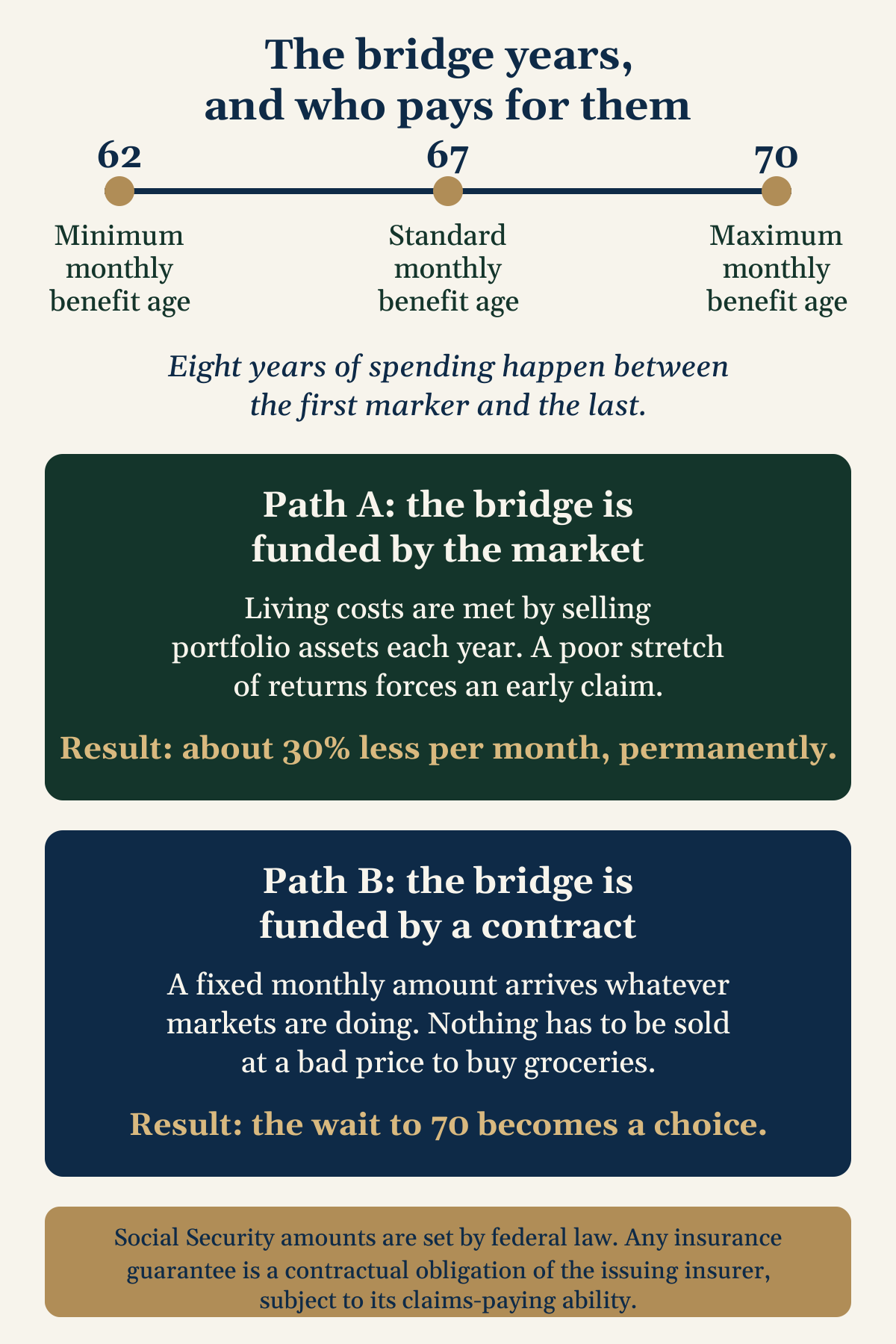
- Claim at 62: your monthly benefit runs about 30% lower than it would at 67, permanently.
- Claim at 67: you receive the baseline amount your earnings record supports.
- Wait past 67: the benefit grows 8% for each full year you delay.
- Claim at 70: three years of that credit means roughly 24% above the age-67 amount.
Two people with identical work histories can collect very different amounts for thirty years, separated only by the age printed on the application.
People are already waiting longer, and paying for it somehow
The Center for Retirement Research at Boston College tracked claiming from 1985 through 2023. The share claiming at the earliest age fell from around 60% to under 30% after 2005.
Average claiming age rose roughly two years, from about 63 to about 65.
Which raises the question nobody puts in a press release. Those extra years were funded from somewhere.
The usual funding sources, and what each one costs
When a household delays claiming, the bridge money almost always arrives from one of four places.
- Working longer. Reliable, until health or an employer decides otherwise, and the option least under your control.
- Drawing down the portfolio. Flexible, and comfortably the most dangerous of the four during a poor market stretch.
- Cash on the sidelines. Safe in nominal terms, but steadily eroded by inflation while it waits.
- Some combination, decided year to year. Common, and the hardest approach to sustain when markets turn against you.
The second option is where I see genuine damage. Selling assets to cover living costs during a down year locks in the loss and shrinks the base that has to recover.
We worked through that arithmetic in why sequence of returns risk is the silent retirement killer. The order of your returns matters roughly as much as their average.
A market-funded bridge is therefore a bet. You are wagering that the eight years before your largest check begins will not contain a bad one.
A market-funded bridge is therefore a bet. You are wagering that the eight years before your largest check begins will not contain a bad one.
Start with the number, not the opinion
Before any of this becomes a strategy, it has to become arithmetic.
Write down what your household actually spends annually, then write down the income arriving regardless of what markets happen to do.
The difference is your gap, and every other decision in the plan exists to cover it.
What’s your income gap?
Your income gap is the part of your essential monthly bills that isn’t already covered by income you can count on. It’s the number guaranteed retirement income has to fill.
Your monthly income gap
$0
Fill in your numbers above and this updates as you type.
- Gap per year$0
- Total, if costs never rose$0
- Total, with costs rising$0
This is simple arithmetic, not a projection, a quote, or a recommendation. It adds up the shortfall between your essential expenses and the income you already count on, and multiplies it out over time. It does not account for taxes, healthcare cost changes, Social Security adjustments, investment returns, or any specific product. Your actual results will differ. Guarantees on annuities and life insurance are backed by the financial strength and claims-paying ability of the issuing insurance company. Talk with a qualified professional before making decisions.
Run the calculation twice: once for the bridge years before claiming, and once for the years afterward.
Those two numbers are rarely close. The first is almost always the bigger one, which is precisely why so many households claim at 62 and call it a preference.
Where secure retirement income for the bridge years comes from
Here is the shift that makes waiting affordable rather than merely admirable.
If a fixed amount arrives every month from a contract rather than a market, the bridge years stop depending on timing. Nothing has to be sold at a bad moment in order to eat.
That arrangement is what we call a private pension: dollars positioned to produce predictable income on a schedule you set.
What the structure does
Four things change when the bridge rests on a contract instead of a market.
- The monthly amount is written down. It is stated in the contract and backed by the issuing insurance company, subject to its claims-paying ability.
- Nothing has to be sold. Your spending no longer depends on what the account happens to be worth in a particular month.
- The larger federal benefit still grows. It keeps earning the 8% credit while the contract covers the household bills.
- The remaining portfolio gets time. Money you are not spending from can stay invested on your own terms.
The tradeoffs, stated plainly
This is a genuine tradeoff rather than a trick, so here is the other side.
Income contracts mean surrendering flexibility. Most annuities carry surrender periods, and committed dollars are not available the way a savings account is.
Payout rates depend on the insurer, your age, and conditions when you sign. Nobody can responsibly tell you what a contract will offer three years from now.
Sure Wealth does not guarantee product performance. The issuing insurer does, strictly within the terms it writes.
If these structures are unfamiliar, start with our explainer on how guaranteed lifetime income contracts work. The wider map of secure retirement income options sits in our guide to retirement income strategies.
Wondering whether your own gap is bridgeable? Schedule a consultation with a licensed Sure Wealth strategist, and we will size the bridge before any product enters the conversation.
Composite illustration
A labeled composite drawn from several client patterns — not an actual client result, and not a projection of any outcome.
Background
A couple, 63 and 61, held roughly $900,000 across an IRA and a brokerage account. Both wanted to wait until 70, and neither could explain how to pay for it.
Approach
We sized the bridge first. Annual spending, minus a small pension, left a defined shortfall for the years before either benefit started.
Outcome
They moved a portion into a contract built to deliver a fixed monthly amount through those years, leaving the remainder invested. Their claiming decision stopped depending on the market. Tax sequencing went to their accountant.
Four questions before you pick an age
Whatever you decide, these four questions do most of the work. Unfamiliar terms are defined in our glossary.
- What does the bridge actually cost? Multiply your annual gap by the years you intend to wait, because the total is usually larger than people expect.
- What happens to my spouse? A survivor generally steps into the higher of the two benefits, so the larger earner’s claiming age affects two lifetimes.
- Can my funding source have a bad year? If the honest answer is yes, then your claiming age is not really your decision.
- What does claiming do to my taxes? Benefits interact with other income and with Medicare premiums, so take the specifics to your tax professional.
That final point hides most of the avoidable cost. We covered the mechanics in understanding tax efficiency in retirement.
Back to the legal pad
The man with the two columns did not have a patience problem. He had a funding problem, and he had already diagnosed it correctly.
We never debated whether 70 was the better age, because his arithmetic had settled that. We spent the hour on the seven years he had to get through first.
Congress has made that conversation easier to begin. Calling 70 the maximum monthly benefit age communicates something true that “delayed retirement” hid for decades.
But a label is not a paycheck. A raise you cannot afford to wait for is not actually a raise.
But a label is not a paycheck. A raise you cannot afford to wait for is not actually a raise.
Build the floor, then choose the age. In that order, secure retirement income stops being a forecast and becomes a schedule.
Two ways to do that work. Schedule a consultation with a licensed Sure Wealth strategist and we will size your bridge together. Or start with the thinking behind it and get the Sure Wealth Way book.
Questions retirees ask about claiming age and bridge income
Does the Claiming Age Clarity Act change my benefit amount?
No, it changes terminology only. The ages, the roughly 30% reduction for claiming at 62, and the 8% per year credit for waiting past 67 are all unchanged. What changes is the vocabulary the Social Security Administration uses.
Is waiting until 70 always the right answer?
No, and anyone telling you otherwise is selling certainty. Health, a shorter life expectancy, an immediate need for cash, or a younger spouse can each point the other direction. The arithmetic favors waiting for most people in average health, which is not the same as everyone.
Can I use an annuity just for the bridge years and not for life?
Some contracts are built to pay a fixed amount for a set number of years rather than for a lifetime. Terms, surrender periods, and payout rates vary considerably between insurers. A licensed agent should walk you through a specific contract before you commit money.
Could I use life insurance cash value to cover the bridge instead?
Households with a properly structured whole life policy already in force sometimes do exactly that. Accessing cash value reduces the death benefit while the balance remains outstanding, and the contract sets the terms. Talk it through with a licensed agent, and confirm tax treatment with your tax professional.
This article is for educational purposes only and is not individualized financial, tax, or legal advice. Sure Wealth Solutions does not guarantee product performance. Any guarantees described are contractual obligations of the issuing insurance company, subject to its claims-paying ability. Social Security benefit amounts and claiming rules are set by federal law and may change. Insurance products are offered through licensed agents. Consult your own tax and legal professionals about your situation. See our Guarantee Notice & Disclosure.